Leisure Culture in Southern Illinois: Winter Edition

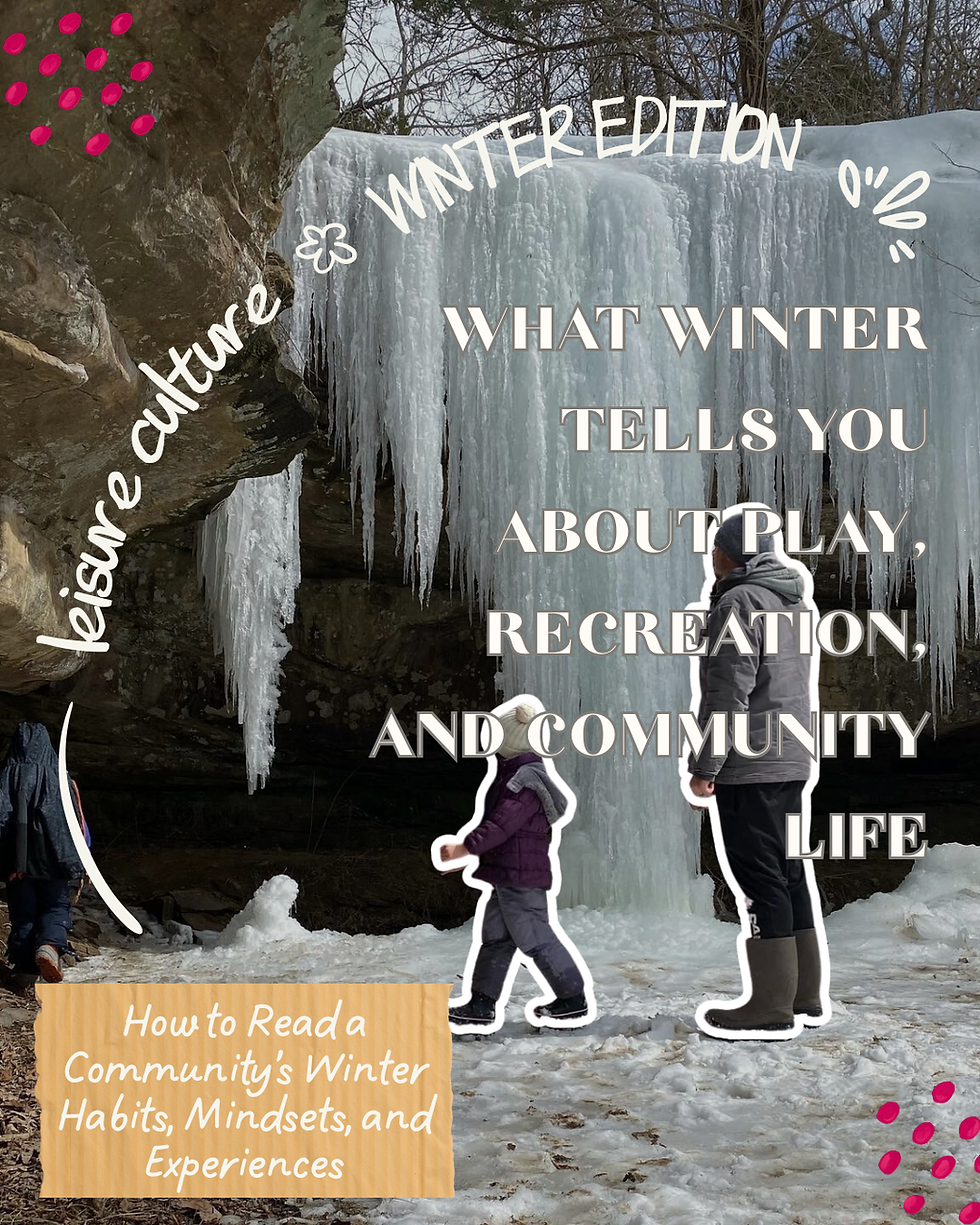
Winter has always been a truth-teller and how we show up during this season reveals the truth living between the lines.
Leisure Culture Is a System, Not a Season
Leisure culture lives in the overlap between people and place. It shows up in what we build, what we maintain, what we celebrate, and what we quietly allow to disappear when conditions change.
Winter doesn’t create or destroy leisure culture, it reveals it.
By paying attention to winter habits, language, and rhythms, we can read a community’s relationship to play, rest, recreation, and one another.
How to Read a Community’s Winter Leisure Culture
1. Local Businesses & Seasonal Readiness
What appears on shelves matters.
Gloves, hats, cozy layers. Books, puzzles, candles. Comfort food. Board games. Local goods meant to be lingered over. These aren’t just retail items, they’re leisure tools.
When Southern Illinois businesses lean into winter with intention, they signal that the season is meant to be lived, not waited out. When they don’t, winter quietly becomes something to endure rather than experience.
Seasonal readiness isn’t about snow gear alone, it’s about acknowledging winter as a valid chapter of community life.
2. Language From Leaders, Media, & Community Voices
Words frame experience.
Is winter spoken about as a burden? A shutdown? Something to “get through”? Or is it framed as a slower rhythm, one with its own beauty, rituals, and opportunities?
Communities that speak about winter as navigable, cozy, and communal build confidence and participation. Communities that speak about it only as disruption unintentionally reinforce retreat.
Language becomes permission.
3. Events That Continue, Even If They Shapeshift
Winter leisure doesn’t require festivals every weekend. It requires continuity.
Book clubs, trivia nights, winter hikes, lectures, craft nights, intimate music, storytelling events, these smaller, lower-lift gatherings quietly sustain culture through the colder months.
In Southern Illinois, where winter may be mild or unpredictable, consistency matters more than scale. When events disappear entirely, leisure collapses inward and isolation fills the gap.
When events adapt instead of vanish, community life stays visible.
4. Infrastructure That Supports Being Out
Cleared sidewalks. Heated patios. Accessible trails. Well-lit town squares. Open restrooms. Warm places to land.
Winter leisure doesn’t demand perfection, it demands intention.
Infrastructure signals whether a community expects people to show up or stay home. When shared spaces are maintained year-round, winter becomes usable. When they aren’t, participation shrinks, even on mild days.
Southern Illinois’ bluffs, wetlands, forests, and lakes don’t close in winter. The question is whether we design around that truth.
5. Community Mindset & Everyday Conversations
Listen closely in winter.
Do conversations lean toward complaint and countdown, waiting for spring, wishing winter away? Or toward adaptation and ritual; slow mornings, fireside gatherings, quiet trails, shared meals?
Communities with resilient leisure cultures talk about winter as something to work with, not against. Even small shifts in mindset create ripple effects across participation, pride, and belonging.
Winter is shaped as much by attitude as temperature.
6. Clubs, Groups, & Shared Winter Rhythms
Southern Illinois winters may not guarantee snow, but they do invite connection.
Winter hiking groups. Walking clubs. Book clubs at local coffee shops. Craft circles. Bonfires. Brewery and winery meetups. Indoor recreation leagues.
These groups keep leisure relational. When people gather; to walk, read, talk, create, or sit by a fire... winter becomes a season, not a pause.
Leisure culture survives through shared rhythm.
7. Local Lodging & the Language of Stay
How lodging speaks about winter matters.
Are Airbnbs, inns, and lodges skipping the season, or reframing it? Are they naming fireplaces, slow mornings, quiet trails, winter light, and storybook towns within the Shawnee National Forest? The language of stay tells visitors, and locals, whether winter belongs on the calendar.
When winter is marketed as cozy, restorative, and grounded, it becomes inviting. When it’s ignored, it becomes invisible.
Where Winter Leisure Falters, And Why It Matters
In Southern Illinois, winter has often been treated as an off-season. Businesses close. Programming pauses. Messaging quiets.
This creates a subtle but powerful signal: leisure resumes later.
The cost isn’t just economic. It’s cultural. When winter is skipped, continuity breaks.
But this isn’t a failure. It’s an unfinished chapter.
Winter isn’t empty, it’s undertranslated.
Reframing Winter for the Long View
Expanding winter leisure culture doesn’t mean forcing activity where it doesn’t belong. It means naming what already exists and building around it with care.
It means:
Translating outdoor assets for winter use
Supporting businesses that stay open and seasonal
Choosing language that invites rather than avoids
Creating rituals instead of waiting periods
Recognizing our own role in how winter is experienced
Leisure culture is built slowly, season by season, generation by generation.
It must be part of the story.


Comments